
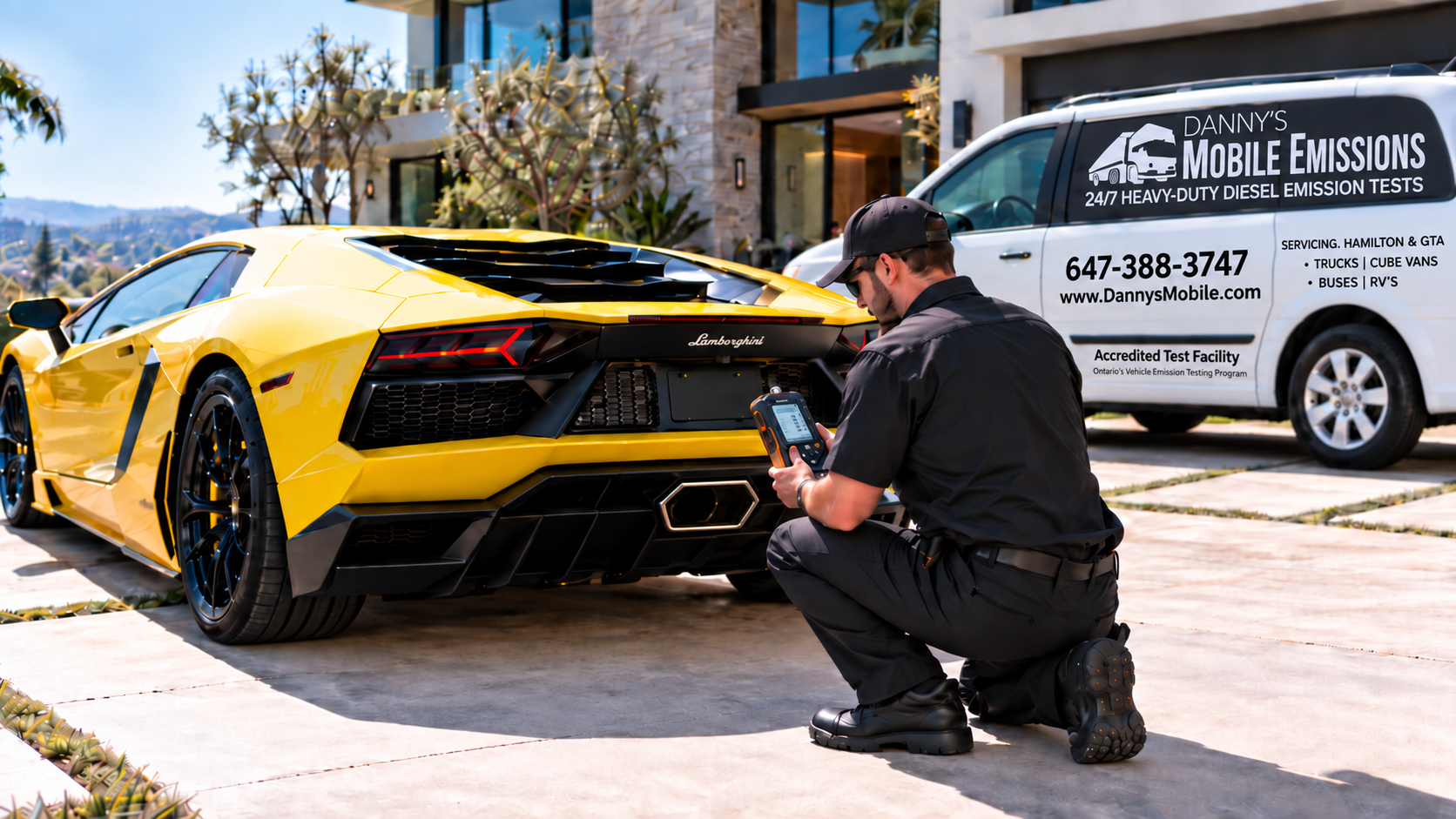
Performance Tuning Emissions Testing
Precision Exhaust Gas Analysis for Race Cars, Exotic Cars & Performance Vehicles
When you're tuning a high-performance engine, horsepower numbers only tell part of the story.
Danny’s Mobile Emissions provides specialized Performance Tuning Emissions Testing for race cars, exotic sports cars, modified vehicles, performance engines and specialty builds.
Using professional multi-gas exhaust analysis and a controlled Two-Speed Idle (TSI) testing procedure, we measure the actual gases being produced by the engine before final catalytic-converter treatment.
This gives tuners and vehicle owners another valuable set of data for evaluating combustion quality, fuel mixture and the effectiveness of tuning changes.
Our process is simple:
Baseline Test → Fine Tuning → Re-Test → Compare Results
We come directly to your shop, garage, race facility or vehicle location.
What Is a Two-Speed Idle Emissions Test?
A Two-Speed Idle test, commonly called a TSI test, analyzes exhaust emissions while the engine operates at two controlled conditions:
Normal Engine Idle
and
Approximately 2,500 RPM at No Load
Testing the engine at both speeds provides a more complete picture than taking a single exhaust reading at idle.
The elevated-RPM portion allows us to observe the engine under a different steady-state operating condition, while the idle test provides a baseline at minimum engine speed.
For performance applications, we use this testing method as a diagnostic and tuning tool rather than a government pass/fail emissions inspection.
Why We Test Before the Catalytic Converter
A catalytic converter is designed to chemically reduce pollutants in the vehicle's exhaust.
That is excellent for controlling tailpipe emissions—but it can make it more difficult to understand exactly what is happening inside the engine during tuning.
For performance-tuning applications, Danny’s Mobile Emissions can sample the exhaust upstream of the catalytic converter where a suitable sampling location is available.
Why pre-catalyst testing matters
Testing before the catalytic converter allows us to evaluate engine-out exhaust gases before the catalytic converter changes their concentrations.
This can give your tuner a much clearer picture of how the engine itself is operating.
Instead of simply seeing what comes out of the tailpipe, we are looking more closely at the combustion process producing those gases.
Our Performance Tuning Emissions Testing Process
1. Initial Vehicle & Engine Assessment
Before testing, we discuss the vehicle configuration with the owner, mechanic, engine builder or tuner.
This can include:
Engine configuration
Naturally aspirated, turbocharged or supercharged setup
Fuel type
Aftermarket ECU or factory ECU
Current modifications
Exhaust configuration
Catalytic converter configuration
Recent engine changes
Current tuning concerns
We then determine the appropriate exhaust sampling location and testing procedure.
2. Pre-Catalyst Baseline Emissions Test
Before additional tuning is performed, we establish a baseline emissions profile.
Where the vehicle configuration allows it, our analyzer samples exhaust gases before the catalytic converter.
The engine is tested at controlled operating conditions including:
Normal Idle
A stabilized exhaust sample is collected with the engine operating at its normal idle speed.
Elevated RPM
The engine is brought to approximately 2,500 RPM under a controlled no-load condition and readings are allowed to stabilize.
This creates a repeatable baseline that can later be compared with the vehicle after tuning.
What Do We Measure?
Depending on the vehicle and testing configuration, our multi-gas emissions equipment can analyze gases including:
Hydrocarbons — HC
Hydrocarbons can provide useful information about unburned fuel leaving the combustion chamber.
Unusual HC readings may help identify conditions involving incomplete combustion or misfire.
Carbon Monoxide — CO
Carbon monoxide is strongly influenced by combustion and air-fuel conditions.
CO measurements can provide additional information to the tuner when evaluating fuel mixture and combustion behaviour.
Carbon Dioxide — CO₂
Carbon dioxide measurements provide another indicator of combustion conditions and are useful when interpreting the overall exhaust gas profile.
Oxygen — O₂
Residual oxygen in the exhaust can provide additional information about combustion, exhaust dilution and potential air entering the exhaust system.
Additional Exhaust Gases
Depending on the testing equipment and application, additional gases may also be monitored to provide a broader emissions profile.
Rather than looking at a single measurement, we evaluate the relationship between multiple exhaust gases.
Tune the Vehicle
Once the initial emissions test has been completed, the tuner or performance shop can make the required adjustments.
These may include changes to areas such as:
Fuel mapping
Injector calibration
Ignition parameters
Idle calibration
ECU programming
Fuel delivery
Engine management settings
Performance modifications
Danny’s Mobile Emissions does not replace the vehicle's tuner or dyno operator.
Instead, we provide independent emissions data that can be used alongside the tuner's existing diagnostic and performance information.
We Come Back and Re-Test the Vehicle
This is where the service becomes especially valuable.
After the vehicle has been fine-tuned, Danny’s Mobile Emissions returns and performs the test again under comparable operating conditions.
The second test allows the before-and-after emissions results to be compared.
Before Tuning
Baseline engine-out emissions profile
After Tuning
Post-tuning emissions profile
Compare
Review how the exhaust gas readings changed following the tuning work.
Instead of relying exclusively on how the engine sounds, feels or performs, you have additional measurable information showing how the combustion characteristics changed.
Before & After Emissions Analysis
Our goal is to provide your tuner with repeatable, measurable data.
Your testing report can document readings such as:
Idle HC
2,500 RPM HC
Idle CO
2,500 RPM CO
CO₂
O₂
Engine RPM
Pre-Tuning Results
Post-Tuning Results
Difference Between Tests
This makes the service useful not only during the tuning process but also for documenting changes to a vehicle over time.
Ideal for Performance & Specialty Vehicles
Our Performance Tuning Emissions Testing service is ideal for:
Exotic Sports Cars
Ferrari
Lamborghini
McLaren
Porsche
Audi R8
Mercedes-AMG
BMW M
Corvette
Nissan GT-R
Other high-performance vehicles
Race & Track Cars
Track cars
Road-racing vehicles
Time-attack builds
Drag cars
Club racing vehicles
Performance street/track builds
Modified Street Cars
Turbocharged vehicles
Supercharged vehicles
ECU-tuned vehicles
Modified intake systems
Modified exhaust systems
Upgraded fuel systems
Performance engine builds
Engine Builders & Performance Shops
We can also work directly with:
Performance tuning shops
Engine builders
Race teams
Dyno facilities
Restoration shops
Exotic vehicle specialists
Independent mechanics
Custom fabrication shops
A Valuable Addition to Dyno Tuning
A dynamometer and an exhaust gas analyzer provide different types of information.
A dyno can measure vehicle or engine performance.
Our emissions testing provides information about the gases being produced by the combustion process at the test conditions.
Used together, these tools can give a tuner a broader understanding of what is happening with the engine.
Our Two-Speed Idle testing is a stationary, no-load emissions analysis and is not intended to replace wideband oxygen monitoring, dynamometer testing or other diagnostics performed under engine load.
Instead, it provides another layer of objective data.
Mobile Testing — We Come to Your Vehicle
You don't need to bring an exotic, race or specialty vehicle to an emissions-testing facility.
Danny’s Mobile Emissions comes to you.
Testing can be performed at:
Performance shops
Dyno facilities
Race shops
Dealerships
Private garages
Vehicle storage facilities
Collector-car facilities
Race facilities
Automotive repair shops
This is particularly convenient for vehicles that are rarely street driven, transported by trailer or stored at specialty facilities.
Performance Tuning Emissions Test Report
After testing, results can be documented so that you and your tuner can compare vehicle performance before and after adjustments.
For vehicles undergoing multiple stages of tuning, additional testing can also be performed to document the progression.
Test 1
Original Baseline
↓
Vehicle Tuned
Calibration / Adjustments
↓
Test 2
Post-Tuning Analysis
↓
Results
Before & After Comparison
Why Test Pre-Catalyst?
For normal emissions compliance testing, exhaust is typically evaluated at the vehicle's exhaust outlet according to the applicable inspection procedure.
Performance tuning has a different objective.
We want to understand what the engine is producing.
The catalytic converter can substantially change the exhaust composition before it reaches the tailpipe.
By sampling upstream of the catalyst where the vehicle provides a suitable testing location, we can obtain an engine-out emissions profile that is more useful for combustion analysis.
This gives your tuner another source of information when fine-tuning the vehicle.
Give Your Tuner More Data
Whether you're fine-tuning an exotic supercar, completing a race engine build or trying to perfect the calibration on a modified street vehicle, exhaust gas analysis can provide information that traditional performance measurements alone may not show.
Danny’s Mobile Emissions can establish your baseline, allow your tuner to make the required adjustments, and then return to verify the results.
Baseline. Tune. Re-Test. Compare.
Book Performance Tuning Emissions Testing
Contact Danny’s Mobile Emissions to schedule mobile emissions testing for your race car, exotic vehicle, performance vehicle or specialty engine.
We come directly to your vehicle or performance shop.
Performance Tuning Emissions Testing FAQs
-
A Two-Speed Idle or TSI test measures exhaust emissions at two steady-state engine speeds. Typically, readings are collected at approximately 2,500 RPM and again at normal idle.
For our performance-tuning service, these readings are used diagnostically rather than as a government pass/fail inspection.
-
The catalytic converter changes the composition of the exhaust gases before they exit the tailpipe. Sampling upstream of the catalytic converter can provide a clearer indication of the emissions being produced directly by the engine.
-
Yes. This service is specifically suited to exotic, performance, collector and specialty vehicles where additional engine and combustion information may be useful during tuning.
-
Yes. We can perform stationary emissions analysis on many race and track vehicles where an appropriate and safe exhaust sampling point is available.
-
Our primary role is emissions testing and exhaust gas analysis. Your performance tuner or engine specialist performs the vehicle calibration. We provide emissions data that can be used as another diagnostic tool during that process.
-
Yes. The service can include an initial baseline test followed by a second visit after tuning has been completed.
This allows us to create a direct before-and-after comparison.
-
No.
Our Performance Tuning Emissions Testing service is a diagnostic exhaust-gas analysis service intended for tuning, troubleshooting and vehicle-performance applications.
It should not be represented as a substitute for an official government emissions inspection where a regulated inspection is required.
-
Not necessarily.
The Two-Speed Idle portion of our service is performed while the vehicle is stationary and unloaded. However, emissions testing can also complement work being performed at a dyno or performance tuning facility.